
The Mass Shift Toward Concentrated Liquid Refills
During early 2021, the global household chemical, personal care, and commercial cleaning industries underwent an unprecedented structural transformation. Driven by surging raw plastic resin costs, container shipping freight spikes, and aggressive corporate carbon-neutrality pledges, major brands aggressively migrated from heavy rigid HDPE and PET bottles to flexible liquid refill spout pouches.
The commercial and environmental math driving this transition is compelling:
- A standard 1,000 mL rigid plastic bottle requires 45 to 65 grams of virgin HDPE plastic.
- An equivalent 1,000 mL high-barrier flexible spout pouch requires only 12 to 16 grams of plastic, achieving an immediate 70% to 80% source plastic reduction.
- In logistics, un-filled rigid bottles ship empty air: one 40-foot shipping container holds approximately 25,000 empty rigid bottles. The same container holds over 250,000 collapsed flexible spout pouches, slashing inbound transport emissions and freight costs by 90%.
However, packaging liquids in high-capacity flexible pouches (500 mL to 3,000 mL) presents severe mechanical engineering hurdles. Unlike dry granular products, liquids are incompressible fluids. When a filled pouch is dropped during parcel courier transit or falls from a retail shelf, internal hydraulic fluid shocks exert extreme transient pressure waves against perimeter heat seals and rigid spout weld lands.
This whitepaper details the structural fitment geometries, polymer blend selections, and drop-impact testing protocols developed by TT Packing to guarantee zero-leak liquid refill performance.
Fitment Fluid Dynamics: High-Flow Spout & Cap Geometries
The injection-molded fitment must satisfy three competing criteria: high filling velocity during automated packaging, smooth non-glug pouring for the consumer, and absolute seal hermeticity.
       [ CROSS-SECTION OF HIGH-FLOW LIQUID SPOUT FITMENT ]

               Threaded Tamper-Evident Anti-Choke Cap
                         +-------------+
                         |  [Air Vent] |
                         +------+------+
                                |
             Anti-Glug Internal | Baffle Tube
                                v
               +-------------------------------+
               |   Top Flange Sealing Collar   |
               +---------------+---------------+
                               |  Spout Diameter: Ø 16mm / 22mm
                               v
                     /===================                    /  Boat-Shaped Base   \  <-- Welding Wing Fins
                   |  [Energy Directors]   |     (Multi-ribbed 0.6mm ridges)
                    \                     /
                     \===================/
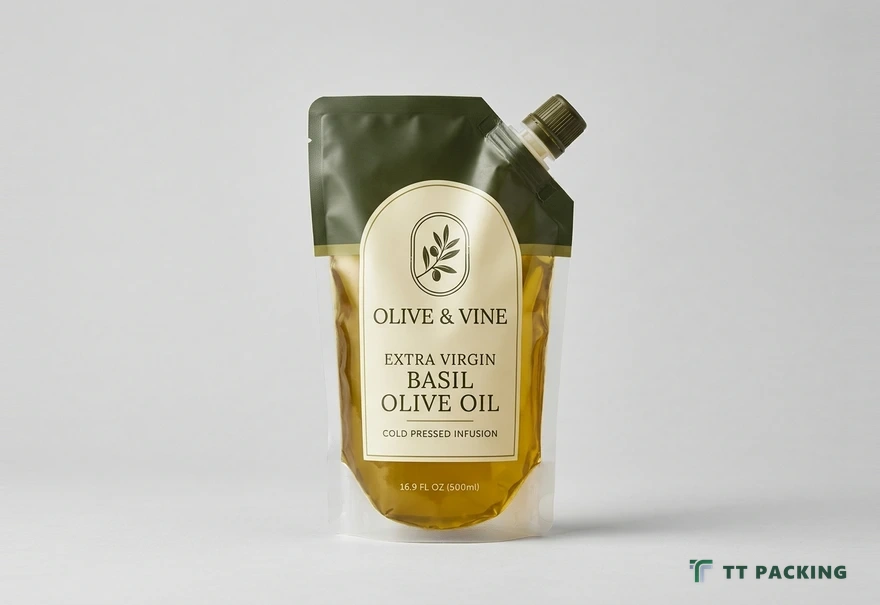 Figure 1: Injection-molded boat-shaped fitment geometry showing ribbed energy directors and anti-glug pour channels.
1. The Boat-Shaped Base Design
The bottom flange of a spout fitment is molded into a streamlined diamond or "boat" geometry with tapered lateral wing fins.
- Sharp angles create stress risers that pinch the flexible film during corner insertion.
- Tapered wing tips ($< 15^\circ$ angle) allow the film plies to transition smoothly from flat two-ply contact to four-ply fitment encapsulation, eliminating step-down micro-channel leaks.
2. Multi-Ribbed Energy Directors
The exterior sealing faces of the boat base feature dual or triple parallel triangular energy directors (0.5 to 0.8 mm height). When clamped by ultrasonic horns or thermal sealing tools, heat and pressure concentrate at these acute apexes, causing the HDPE/LLDPE resin to melt and flow rapidly into microscopic surface irregularities on the film's inner sealant web.
3. Anti-Glug Air Venting Channels
When consumers pour high-viscosity liquids (such as laundry detergent or liquid hand soap) from a flexible pouch, liquid discharge creates a partial vacuum in the pouch headspace. This causes the flexible sidewalls to flutter and collapse, resulting in violent liquid splashing ("glugging").
- TT Packing's high-flow spouts (16 mm and 22 mm inner diameter) incorporate an internal dual-channel baffle: liquid flows through the primary lower aperture while a secondary upper micro-channel admits ambient air, equalizing internal pressure for a smooth, steady pour stream.
Drop Impact Hydraulics: Surviving the 1.8-Meter Free Fall (ASTM D5276)
When a 1.5-liter liquid pouch impacts a concrete floor, kinetic energy converts into hydraulic water-hammer pressure waves exceeding 0.8 to 1.2 MPa within milliseconds. Standard polyester/polyethylene laminates shatter under this transient hydraulic surge.
To ensure survival through rigorous courier testing (e.g., Amazon ISTA 6-Amazon.com Project Over Boxing protocols), the laminate substrate must combine high tensile yield strength with exceptional high-elongation energy absorption:
1. The BOPA (Biaxially Oriented Nylon) Energy Sponge
Flexible liquid pouches must incorporate a 15 $\mu$m BOPA layer:
- BOPA exhibits an extraordinary elongation at break ($> 85%$) and high tear initiation resistance ($> 120$ N).
- During drop impact, the nylon web stretches elastically like a trampoline, absorbing and redistributing the concentrated fluid shock across the broad surface area of the pouch walls, shielding the rigid spout weld from concentrated peel shear.
2. Metallocene Sealant Formulations
The sealant ply must avoid stiff, low-molecular-weight polyethylenes. We blend high-molecular-weight Metallocene Linear Low-Density Polyethylene (mLLDPE) with polyolefin plastomers (density $0.902,\text{g/cm}^3$). This delivers superior Hot-Tack Bond Strength and extreme ductile fracture resistance even when contaminated by liquid surfactant formulations.
Technical Comparison: 4 Liquid Barrier Laminate Formats
The table below contrasts physical properties across four specialized liquid pouch barrier constructions evaluated under standardized ASTM mechanical and barrier protocols:
| Substrate Construction | Total Gauge | Pouch Burst Pressure (ASTM F1140) | Drop Height Survival (ASTM D5276 - 1.5L Water) | OTR (ASTM D3985)cc/m²/24hr |
Chemical Resistance (Surfactants / Oils) | Primary Target Application |
|---|---|---|---|---|---|---|
| PET 12 / NY 15 / LLDPE 110 | 137 μm (5.4 mil) | > 360 kPa | 1.8 Meters (100% Pass) | 22.0 - 35.0 | Superior (Highly Resistant) | Heavy Laundry Detergent, Fabric Softener Refills |
| PET 12 / AL 7 / NY 15 / mLLDPE 100 | 134 μm (5.3 mil) | > 420 kPa | 2.0 Meters (Heavy Duty) | < 0.05 (Hermetic) | High (Requires Barrier Foil) | Essential Oils, Food Purees, Liquid Fertilizers |
| PET 12 / EVOH-PE 100 (Clear) | 112 μm (4.4 mil) | > 310 kPa | 1.5 Meters | 0.80 - 1.50 (High Clarity) | High | Liquid Hand Soaps, Shampoo Refills, Window View |
| MDO-PE 25 / Mono-PE 95 (Recyclable) | 120 μm (4.7 mil) | > 290 kPa | 1.5 Meters | 1.50 - 2.80 | Good | 100% Recyclable Eco-Refill Pouches (#4 PE) |
Top-Spout vs. Corner-Spout Pouch Structural Ergonomics
Selecting the correct fitment placement dramatically influences filling line speeds and consumer handling:
- Corner 45-Degree Spout Placement:
- Advantages: Placing the spout at a 45° angle on the top shoulder leaves the center top horizontal seal free for dedicated automated filling nozzles. Allows rapid bottom or top fill before fitment capping.
- Ergonomics: Provides an intuitive pouring angle that naturalizes wrist movement when pouring into narrow bottle necks.
- Center Top Spout Placement:
- Advantages: Symmetrical weight distribution, ideal for large-capacity family refill pouches (2L to 5L) equipped with integrated die-cut top carry handles.
- Filling Mode: Filled directly through the spout fitment using automated rotary filling and capping carousels.
5-Point Quality Control Checklist for Liquid Spout Pouch Batches
TT Packing validates all custom manufactured liquid spout pouches through five certified quality auditing protocols:
- Audit Step 1 - Ultrasonic Spout Weld Tensile Verification: ASTM F88 peel testing of the welded spout wings; parent film must tear cohesively ($> 45$ N/15mm) before the fitment weld separates.
- Audit Step 2 - Vacuum Bubble Leakage (ASTM D3078): Water-filled pouches submerged in a vacuum chamber at -70 kPa for 60 seconds; zero micro-bubble emissions permitted from fitment or seals.
- Audit Step 3 - Multi-Axis Free Fall Drop Testing (ASTM D5276): Pouches filled to nominal volume dropped from 1.8 meters onto concrete (horizontal face drop, bottom gusset drop, and direct corner spout drop); zero ruptures across 30 drops.
- Audit Step 4 - Continuous Compression Pallet Stack Test: Filled pouches subjected to static compressive load of 250 kg for 72 hours simulating bottom-carton pallet loads; zero pressure decay or weeping seams.
- Audit Step 5 - Cap Removal Torque & Tamper-Banding: Precision torque tester verification ensuring child-safe tamper-evident break-band separates smoothly within calibrated adult opening limits ($1.8 ext{ to } 2.6 ext{ N}\cdot ext{m}$).
Partner with TT Packing for High-Performance Liquid Spout Packaging
TT Packing operates high-precision automated pouch-making lines equipped with servo-driven ultrasonic spout fitment welders and cleanroom pouch assembly stations.
Our liquid packaging support package includes:
- Engineered CAD Spout Dielines: Tailored pouch volume dielines (250 mL to 5 L) with custom handle reinforcements and ergonomic corner angles.
- Pre-Welded Liquid Test Pouch Kits: Production-grade sample spout pouches sent for your automated liquid filling trials (express courier cost 100% credited against your initial production order).
- ISTA Drop & Transport Laboratory Certification: Certified test reports validating drop resistance and hydraulic burst capacity for e-commerce distribution.

Spout Pouches
Spout pouches represent a transformative alternative to heavy rigid plastic bottles and glass containers. Engineered with specialized multi-layer laminates and precision-welded spout fitments, they prevent oxidation, eliminate spills, and reduce plastic usage by up to 70%.